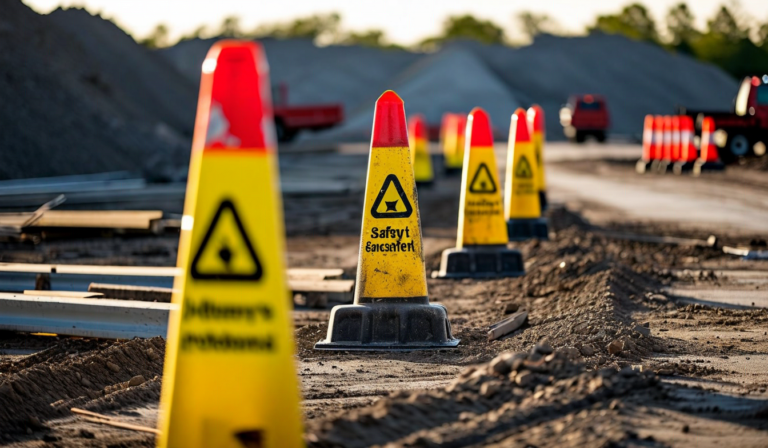
The construction industry accounts for approximately 20% of all U.S. worker fatalities despite employing roughly 5% of the workforce. The "Fatal Four" - falls, struck-by incidents, electrocution, and caught-in/between accidents - account for nearly 60% of construction deaths annually. These statistics have barely moved in a decade despite extensive OSHA enforcement, improved PPE, and widespread safety training programs. Autonomous construction systems do not merely improve safety metrics within the existing paradigm - they change the exposure profile of the work itself.
Exposure Reduction vs. Accident Prevention
Conventional construction safety focuses on accident prevention: proper fall protection equipment, exclusion zones around heavy equipment, electrical lockout/tagout procedures, confined space protocols. These measures reduce the probability of an accident occurring in a given exposure event. They do not reduce the number of exposure events - a framing crew still spends 400 person-hours at elevation to complete a typical home.
Autonomous framing and masonry systems reduce exposure events by removing workers from the highest-risk task categories. When a robot does the work at elevation, the fall exposure belongs to the machine rather than a person. When a robot operates in the struck-by zone around material placement operations, the at-risk entity is steel and electronics rather than a human body. The safety improvement comes from a structural reduction in human exposure time, not from better management of the same exposure.
The Terran Safety Architecture: Design Constraints
Terran's safety system was designed around one non-negotiable constraint: a Terran robot must never cause a recordable injury to a site worker or bystander. This is not the same as saying robots are inherently safe. Robotic arms exert significant force; mobile platforms can pinch limbs; material being lifted can fall. The safety architecture must prevent these outcomes actively and reliably, not just make them unlikely.
The primary safety system is a 3D LiDAR perimeter that establishes a 2.5-meter dynamic exclusion zone around each operating robot unit. Any person or object entering the exclusion zone triggers an immediate stop within 150 milliseconds - faster than the human blink reflex. The 150-millisecond response time was validated against the slowest realistic approach speed of a person stumbling toward an operating robot, ensuring that a worst-case entry into the exclusion zone results in a full stop before contact.
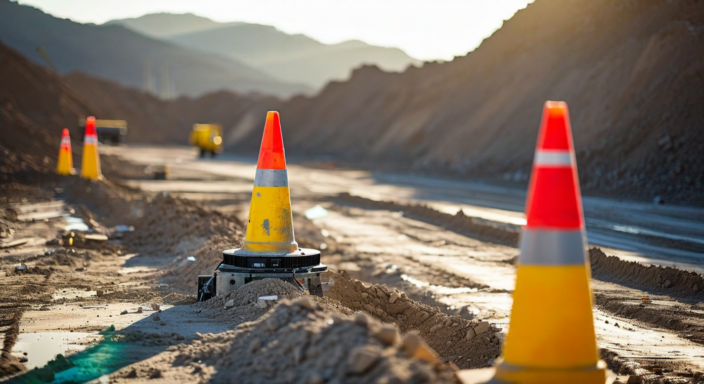
The secondary safety system is a redundant camera-based object detection network. If the LiDAR perimeter system fails, the camera detection layer activates as the primary stop trigger. The two systems use separate hardware and separate power supplies so that a single component failure does not disable both. Monthly functional tests verify that the redundancy is operative, and failures are reported to the Fleet Command Center with an alert that prevents the unit from resuming operations until the primary system is restored.
Human-Robot Zone Separation Protocol
Site layout for a Terran deployment uses a zone separation model rather than integrating robots and workers in the same physical space. Active robot work zones are physically demarcated with orange barrier fencing and flagged as exclusion zones in the Fleet Command Center. Workers performing conventional tasks - utility rough-in, inspection access, material staging - are routed through the site layout to avoid concurrent presence in the active robot zones.
This is not always achievable. Complex sites with limited access routes require robots and workers to share corridors. For these scenarios, the Fleet Command Center maintains a worker proximity protocol: when a worker access credential is detected within 10 meters of a robot zone boundary (via hard hat RFID), the robot reduces its maximum movement speed by 50% and activates a secondary audio alert. The robot does not stop, but it operates at a reduced envelope that provides additional reaction time if the worker enters the exclusion zone unexpectedly.
Fatigue and Distraction: The Human Factors That Don't Apply
OSHA incident data consistently shows that construction accidents are concentrated in the late morning and mid-afternoon - the periods when worker fatigue and complacency peak after hours of physically demanding work. This temporal pattern reflects a human factors reality: attention and physical coordination degrade with fatigue in ways that increase risk during repetitive high-hazard tasks like working at elevation or near moving equipment.
Autonomous systems do not experience fatigue. A robot performing a framing task at hour 10 of a shift operates with the same positional accuracy, the same exclusion zone sensitivity, and the same stop response time as it did at hour 1. This matters particularly for the construction industry because mandatory rest breaks and shift length limits - effective in theory - are poorly enforced and often culturally resisted on job sites where piece-rate pressure incentivizes continuous work.
The elimination of fatigue-related risk does not make robotic systems zero-risk. Mechanical fatigue - material wear in robotic joints, bearing degradation, hydraulic seal deterioration - creates its own failure modes that must be managed through preventive maintenance schedules. The Terran platform's predictive maintenance system monitors joint load signatures and vibration patterns, flagging units for inspection when readings deviate from baseline. This is a different kind of safety management than the human factors approach, but it is one that can be systematized in ways that human fatigue management cannot.
The Supervisor's Role in Autonomous Safety
A single human supervisor monitors the Terran Fleet Command Center during robot operations. This role is safety-critical in ways that differ from the conventional site foreman's job. The supervisor is not managing a crew's physical safety in real time - the robots handle their own safety zones. The supervisor is monitoring the system-level state: identifying robot units that are operating outside normal performance envelopes, managing the zone separation schedule when human trades need access to robot work areas, and making the stop/proceed decision when the AI planner presents a scenario requiring human judgment.
Training for this role takes four days, compared to the years of experience required to supervise a conventional masonry or framing crew. The knowledge required is different - systems monitoring, basic robot maintenance, OSHA General Industry safety standards for autonomous equipment - rather than the deep craft knowledge of a journeyman tradesperson. This is not a comment on the value of craft knowledge; it is an observation that the safety-relevant skill set for robot supervision is more rapidly acquired.
Incident Data from Field Deployments
Across Terran's field deployments, we have recorded zero recordable incidents in over 2,100 operating hours. The exclusion zone stop system has activated 847 times across those hours - an average of approximately one stop per 2.5 operating hours. Of those 847 stops, 91% were triggered by tool attachments or material objects entering the exclusion zone rather than personnel. The remaining 9% - 76 personnel-triggered stops - involved site workers approaching the boundary unexpectedly in all cases. No contact occurred in any of those 76 events.
These figures will evolve as deployment scale increases, but the pattern is consistent with what the physics of the safety architecture predicts. The exclusion zone works because the response time is shorter than the minimum approach time from boundary to contact at any realistic movement speed. As we covered in our discussion of structural quality assurance, the same data logging infrastructure that captures positional accuracy data also captures all safety system activations, creating a continuous safety audit trail for every deployment.
Where the System Does Not Replace Human Safety Judgment
Robotic systems handle the safety of the tasks they perform. They do not handle the safety of adjacent conventional work. When a traditional concrete crew is pouring a slab adjacent to a robot framing zone, the pour crew's fall protection, silica exposure management, and tool safety remain the responsibility of their superintendent. The robot's presence does not make the site safer for activities the robot is not performing.
The most consequential safety improvement from autonomous construction is not the zero-incident record on the robot's own operations. It is the reduction in the number of person-hours spent performing the highest-risk task categories. Every framing hour completed by a robot rather than a human worker is an exposure event removed from the workforce risk pool - and that cumulative exposure reduction is where the industry-level safety improvement will ultimately register.
Safety Documentation for Your Project
Request our safety architecture overview and incident data summary for use in project safety planning submissions.
Request Documentation