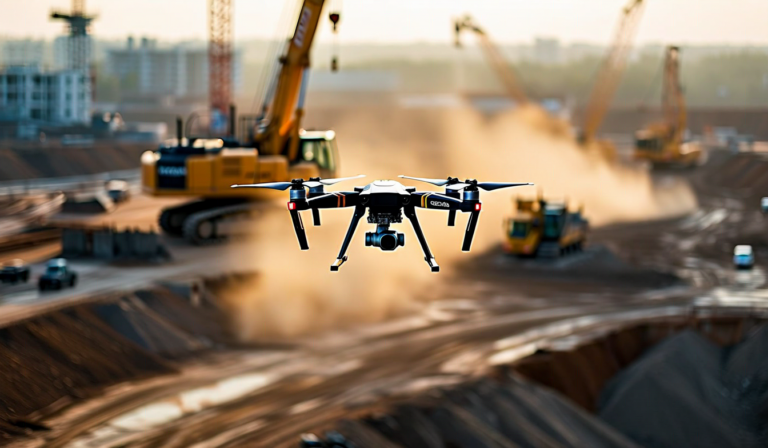
Construction site surveying has improved dramatically in the last decade with the adoption of UAV photogrammetry and LiDAR-equipped drones. What most implementations have in common is that they treat drone surveying as a data capture event - fly the mission, process the point cloud, import to design software, make decisions. The missing piece is the feedback loop that connects the survey data to the machines doing the work in real time. That is where ground robots and aerial drones, operating as a coordinated system, produce capabilities that neither achieves alone.
What Drones Do Well and Where They Stop
Aerial drones equipped with LiDAR or photogrammetry payloads excel at large-area topographic mapping, progress monitoring across an entire site in a single flight, and capturing the configuration of elements that are visible from above. A 30-minute drone flight over a typical residential construction site can produce a point cloud with 2 to 5 centimeter resolution across the full site area, processed into a digital surface model within 2 to 4 hours.
What drones cannot do is capture the vertical face of structures, the underside of framing, or the interior of partially enclosed spaces. A drone flying at 30 meters captures an excellent plan view of foundation work but cannot capture the interior face of a stem wall that will be critical for verifying anchor bolt placement. A drone monitoring framing progress sees roof deck and top plates well; it sees rim joists and interior wall framing poorly or not at all because the structural elements below block the aerial view.
These are not fixable by flying lower or using higher-resolution sensors. They are geometric limitations of the aerial perspective. Any structural element that is not visible from above is a data gap for an aerial-only survey system.
Ground Robots as Complementary Survey Platforms
Ground-based mobile robots equipped with LiDAR and cameras capture the views that aerial drones cannot. A ground robot navigating through partially-framed structure captures all four faces of every wall panel, every connection detail at eye level, and every interior element that the aerial view misses. Combined with the aerial point cloud, the ground robot data fills the geometric gaps to produce a survey data set that covers the full three-dimensional configuration of the structure.
The challenge with ground robot surveying is navigation. A construction site is a dynamic, unstructured environment with changing obstacle configurations, variable surface conditions, and temporary features - formwork, stored materials, equipment - that block or alter the navigation paths used on a previous survey. Ground robot navigation on construction sites requires a more robust autonomy stack than factory or warehouse robots, which operate in structured, static environments.

Terran's ground survey robots use a combination of LiDAR-based simultaneous localization and mapping (SLAM) and visual odometry to navigate in construction environments. The SLAM system builds a real-time map of the environment as the robot moves through it, using that map for subsequent navigation without requiring a pre-built floor plan. This allows the robot to operate in areas of the site that changed since its last visit - adding new framing members, removing temporary shoring - without requiring a manual update to its navigation map.
How the Two Systems Work Together
The Terran survey workflow sequences aerial and ground capture to exploit the strengths of each. The daily aerial mission provides an updated site overview with sufficient resolution to monitor gross progress - which foundation sections are poured, which walls are framed, which sections of the building are enclosed. This data is processed within 2 hours and loaded into the Fleet Command Center as the background context for the day's robot task planning.
The ground survey complements the aerial data at a higher resolution for the specific work zones where robots are operating. Before a robot begins working in a new zone, the ground survey robot is dispatched to capture the current condition of that zone in detail. The resulting point cloud, registered against the aerial survey and the project BIM model, gives the robot task planning system the as-built geometry it needs to plan precise work paths. After robot work in the zone is complete, a follow-up ground survey captures the as-built configuration for the QA record.
This integrated workflow reduces the amount of manual measurement that field teams must perform. In conventional construction, site engineers spend 30 to 60 minutes per day taking manual measurements to verify as-built conditions against design. The automated survey loop reduces that to 10 to 15 minutes of human review of the processed survey data, with manual measurement only required for the specific items where the automated system's confidence is below the verification threshold.
RTK-GPS and Survey Control Integration
Both aerial and ground surveys must be georeferenced to the same coordinate system as the project's BIM model to enable the position accuracy required for robot task planning. This requires establishing survey control points across the site that are measurable by both the drone (visible from above, marked on the ground surface) and the ground robot (accessible at ground level, identifiable to the robot's sensor system).
Real-time kinematic GPS (RTK-GPS) provides centimeter-level absolute positioning for both systems. The RTK base station is established at a stable, unobstructed location on or near the site and transmits corrections to the rover units on both the drone and the ground robot. This allows both platforms to position their survey data within 2 to 3 centimeters of absolute accuracy in the project coordinate system, sufficient for the BIM model registration that robot task planning requires.
In urban infill sites where RTK-GPS accuracy is compromised by multipath reflections from adjacent buildings, the system supplements GPS with total station reference points and ground-based visual targets. The redundant referencing adds 30 to 45 minutes to the initial site setup but provides robust coordinate system accuracy throughout the project.
Progress Monitoring and Schedule Analytics
Beyond robot task support, the integrated survey system generates progress data that feeds directly into the AI planning system's schedule management. The daily aerial survey data is compared against the project BIM model to compute a completion percentage for each defined work package. This comparison is not a human estimate; it is a geometric comparison of the as-built point cloud against the design model geometry.
Work packages that are behind schedule by more than 10% trigger a review in the Fleet Command Center, presenting the behind-schedule work items with the planning system's options for schedule recovery. This real-time progress tracking replaces the conventional approach of weekly site walk reports that may not reflect the current state accurately and that take 2 to 4 hours of superintendent time to produce.
As we noted in our discussion of AI-driven construction planning, the planning system's dynamic replanning capability depends on accurate current-state data. The integrated survey system is what makes that current-state data available continuously rather than at manual reporting intervals. The combination of automated survey capture, automated progress computation, and AI-driven schedule replanning creates a project management feedback loop that is qualitatively different from the manual-report-based management model that most construction projects use.
Regulatory Considerations for Site Drones
Construction site drone operations in the U.S. require compliance with FAA Part 107 regulations: pilot certification, operational limits (below 400 feet AGL, within visual line of sight, daylight only unless waived), and site notification requirements in controlled airspace. Most urban construction sites within a few miles of an airport are in Class D or Class C airspace that requires LAANC authorization for each flight. Terran's standard deployment includes licensed drone operators and a site-specific LAANC authorization process as part of the pre-deployment setup.
The visual line of sight requirement is the most constraining for large sites. Automated beyond-visual-line-of-sight operations, which would allow a single operator to manage drone surveys across multiple sites simultaneously, require FAA waivers that are currently issued on a limited basis. This regulatory constraint will evolve as the FAA's BVLOS rulemaking process proceeds, and Terran is participating in FAA pilot programs for construction-site drone operations to help shape practical compliance frameworks for the industry.
Add Survey Intelligence to Your Project
Ask us how the integrated drone-robot survey system can support your project's schedule and QA requirements.
Request a Demo