
The promise of BIM-to-robot integration is that a designer's digital model becomes directly executable by automated construction equipment - eliminating the interpretation layer where information gets lost, misread, or ignored between the office and the field. The reality is more nuanced. BIM models contain the right information in principle; making that information reliably usable by robotic systems requires solving a set of format, completeness, and real-world reconciliation problems that the BIM vendors have not fully addressed and that construction robotics companies must solve themselves.
What IFC Actually Contains
The Industry Foundation Classes (IFC) format is the open standard for BIM data exchange. An IFC export from Revit, ArchiCAD, or Tekla contains geometry defined in the Open CASCADE format, material properties, spatial relationships between elements, and object classification using the IfcProduct hierarchy. For a structural wall, the IFC data includes the wall's base geometry (swept solid or CSG representation), its material assignment (IfcMaterial or IfcMaterialLayer), its structural function (load-bearing or non-load-bearing), and its connections to adjacent elements through IfcRelConnects relationships.
This is a rich data set. It is also incomplete for robotic execution in several important ways. IFC does not natively encode construction sequence - the standard does not have a data type for "this wall must be built before that wall." It does not encode robot positioning requirements - where a robot should stand to perform each task. It does not encode tolerance specifications at the element level - whether this particular wall joint requires 2mm tolerance or 5mm tolerance. And it does not encode the as-built conditions that may differ from design intent because of site conditions or approved field modifications.
The Model Quality Problem
BIM models vary enormously in quality and completeness. A Level of Development (LOD) 300 model - which most designers consider suitable for construction documents - specifies element geometry, quantity, shape, location, and orientation to a level adequate for human interpretation. It is frequently inadequate for robot execution because humans interpret ambiguous or missing information using judgment and experience, and robots cannot.
Common quality problems in BIM models received for Terran deployments include: walls that intersect other elements without properly modeled connection geometry, floor levels that are not precisely defined in the vertical axis, structural elements that are present in the architectural model but absent from the structural model (or vice versa), and MEP elements that are not yet coordinated and may occupy the same space as structural elements the robot would need to place. Each of these problems requires human review and resolution before robot path planning can proceed.
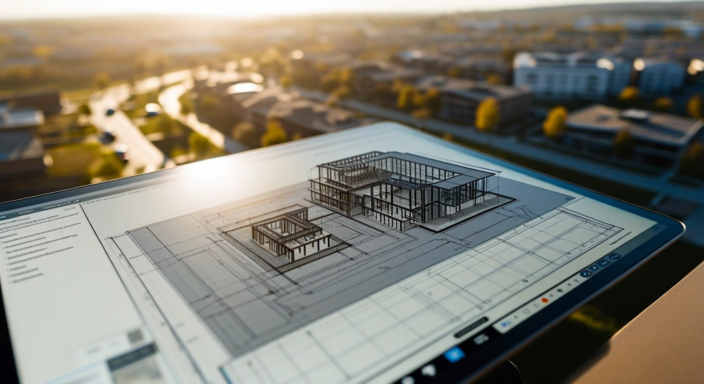
Terran's pre-deployment BIM audit process typically identifies 15 to 40 model issues per project that must be resolved before robot deployment. Most are minor - coordinate reference frame mismatches, duplicate elements, missing material assignments. Approximately 20% are substantive enough to require design team input. The audit adds 1 to 3 days to the pre-deployment timeline, but it eliminates the larger delays and field problems that would result from deploying robots against an unaudited model.
The Coordinate System Challenge
A construction robot operates in a physical coordinate system anchored to survey control points established on site. A BIM model uses a design coordinate system anchored to an arbitrary project origin set by the designer. Connecting these two coordinate systems precisely is a step that seems simple but introduces meaningful error if not executed carefully.
The standard approach uses at least three survey control points, precisely located using GPS or total station survey, that are also identifiable in the BIM model. The transformation from BIM coordinates to site coordinates is computed from these three points. Errors in the survey control points - which can result from GPS multipath error, total station setup errors, or control point marks that have shifted since they were established - propagate into every robot position in the entire deployment.
Terran's field process uses a minimum of five survey control points rather than three, using the redundant points to compute and verify the transformation residuals. If any residual exceeds 5mm, the operator identifies and resolves the discrepancy before proceeding. This verification step takes an additional 30 to 45 minutes in the site setup process but eliminates the systematic positioning errors that insufficient survey control has caused in other robotic construction deployments.
Handling Design Changes Mid-Construction
Construction projects generate design changes. An owner changes a window size. A structural engineer issues a revised beam schedule. A field condition requires relocating a bearing wall. These changes, routine in conventional construction, are more disruptive in a robotic deployment because the robot task sequence was generated from the original model.
The Terran platform handles design changes through a change management workflow that begins with a revised IFC export from the design team. The AI planning system performs a differential analysis between the original and revised models, identifying the specific elements that changed and the tasks in the existing schedule that are affected. Tasks that have not yet been executed are updated automatically if the change is within the system's automatic handling range (geometry changes under 100mm, material substitutions with equivalent properties). Changes outside this range generate a human review alert that presents the affected tasks and the planning system's proposed response for operator approval before the updated schedule is pushed to the fleet.
Data Flow Back to the BIM Model
One underappreciated aspect of robotic construction integration is the data flow in the reverse direction: from the robot's execution back to the BIM model. Every robotic placement generates actual-position data: the as-built coordinates of each element placed, measured to 3mm accuracy. This data is more accurate than traditional as-built surveys, which are typically performed manually at project close using tape measures and laser distance tools.
The Terran platform exports an as-built IFC model at project close, populated with the actual positions recorded during construction. This as-built model is valuable for the building's lifecycle - facility management, future renovation planning, compliance documentation - in ways that a design model with assumed as-built positions is not. Several lenders and owners participating in early Terran deployments have requested the as-built IFC as a project deliverable, recognizing its value for asset management independent of the construction efficiency benefits.
BIM Adoption in the Residential Market
There is a meaningful gap between the BIM adoption rate in commercial construction and in residential construction. Large commercial projects - hospitals, office buildings, multifamily over 5 stories - routinely use Revit or similar BIM tools with LOD 300 or better models. The residential market, particularly the single-family and small multifamily segment, uses BIM far less consistently. Many smaller builders work from 2D CAD drawings or even PDF plans without a 3D model at all.
This presents a practical challenge for robotic construction in the residential segment. Terran's current workflow requires a BIM model as input. For builders without existing BIM capabilities, the pre-deployment process includes a modeling step where Terran's technical team produces a working model from the builder's 2D drawings. This adds cost and time to the first project but establishes a BIM workflow that the builder can use independently on subsequent projects. As we explored in our discussion of AI-driven construction planning, the front-loaded BIM investment pays dividends throughout the project lifecycle that extend well beyond the robotic construction phase.
BIM Consultation for Your Project
Our technical team can review your existing BIM model or help establish BIM workflows for your projects.
Talk to Our Team